
What Changed in the Army Height and Weight Standards on July 7, 2026
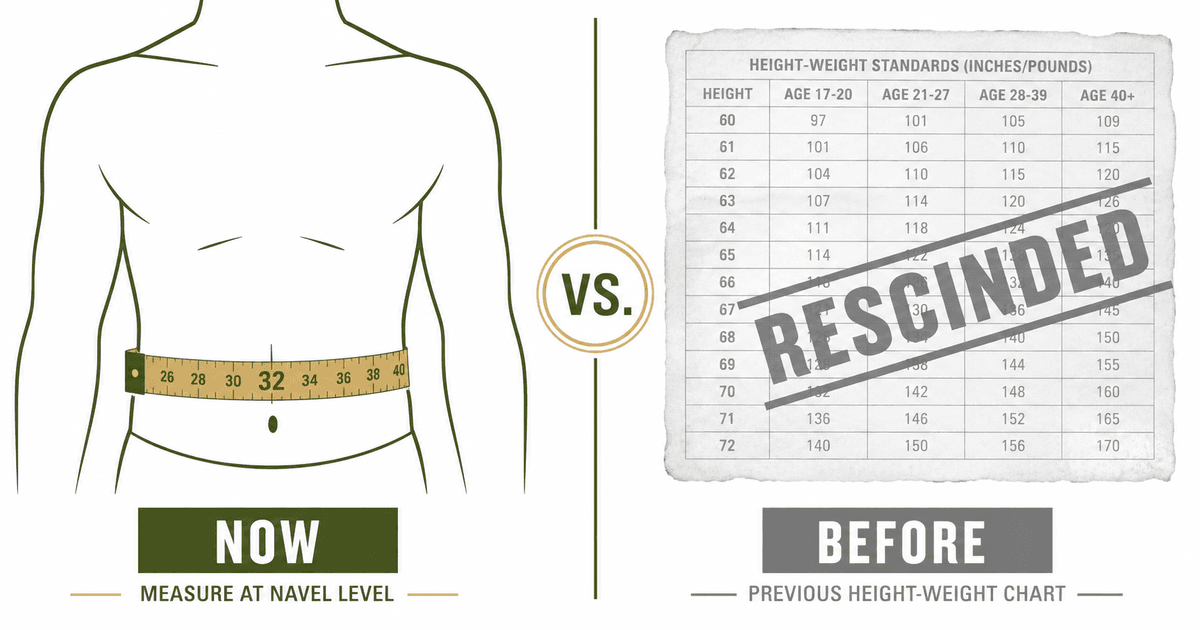
Cover image: U.S. Army reference illustration.
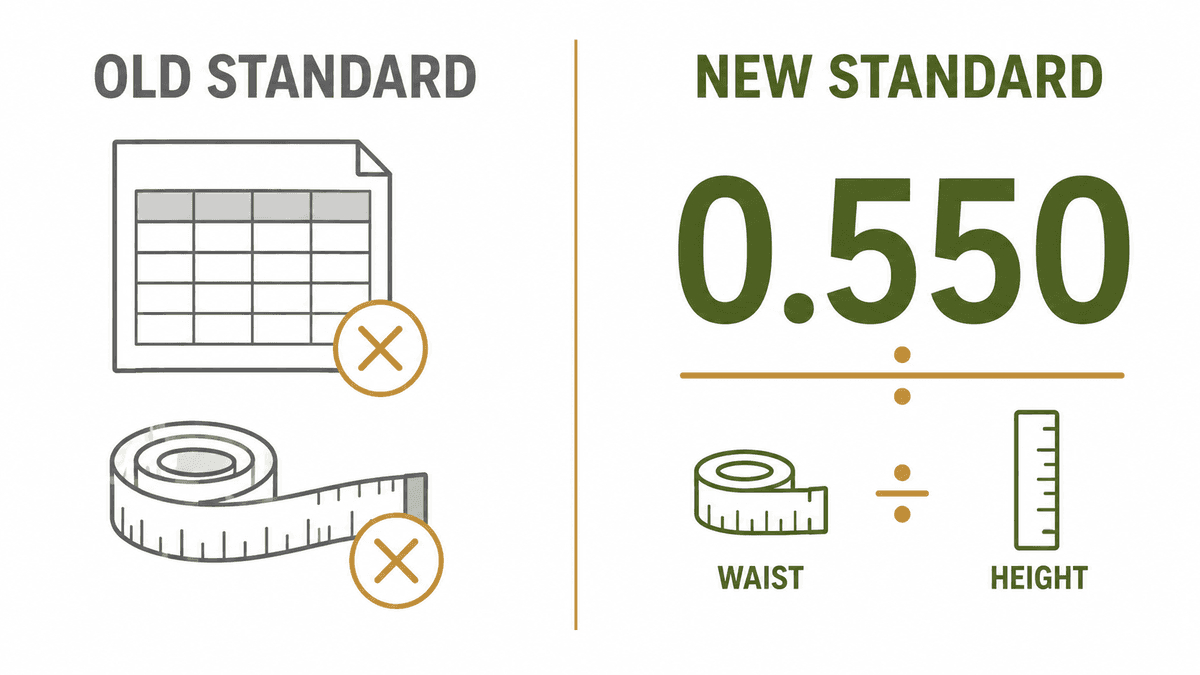
Army Directive 2026-13, effective July 7, 2026, rescinded the height and weight screening tables and every version of the tape test. The Army's sole body composition standard is now waist-to-height ratio (WHtR): waist at the navel divided by height, both in inches. A result below 0.550 meets the standard, with no age or gender adjustment.
What Replaced the Tape Test?
Waist-to-height ratio (WHtR) replaced the tape test, the height/weight screening tables, and every supplemental body fat method, including DEXA, InBody, and Bod Pod. WHtR is a single number: waist circumference at the navel divided by height, both measured in inches and rounded to the nearest half inch. No body fat percentage is calculated anymore.
How Do the Old and New Standards Compare?
The table below lines up the old, rescinded system against the current standard side by side.
| Old (Rescinded) | New (Current, since July 7, 2026) | |
|---|---|---|
| Screening method | Height/weight table; only taped if over the max weight for height | Waist-to-height ratio (WHtR) measured for every Soldier, every cycle |
| Body fat assessment | One-site (navel) or classic multi-site (neck/waist/hips) tape converted to an estimated body fat % | None: WHtR is the standard itself; no body fat percentage is calculated |
| Age adjustment | Four brackets (17–20, 21–27, 28–39, 40+), each with a different limit | None: one 0.550 threshold applies at every age |
| Gender adjustment | Separate, higher limits for female Soldiers | None: the same 0.550 threshold applies to every Soldier |
| Fitness-test exemptions | AFT/ACFT score of 465+ (with 80+ in every event) exempted a Soldier from taping | None: AFT and WHtR are fully independent; no score grants an exemption |
| Forms used | DA Form 5500 (male) / DA Form 5501 (female) | DA Form 5500 only; DA Form 5501 is discontinued |
| Frequency | Twice yearly | Twice yearly (unchanged) |
If you need the old tables for reference, they're preserved (clearly labeled as historical) on the archived height and weight calculator. The archived body fat calculator keeps the retired tape test formulas running the same way, for anyone researching prior policy. If you also track fitness test scores, the AFT Calculator is a separate tool: AFT and WHtR are no longer connected in any way.
When Did the New Standard Take Effect, and How Did We Get Here?
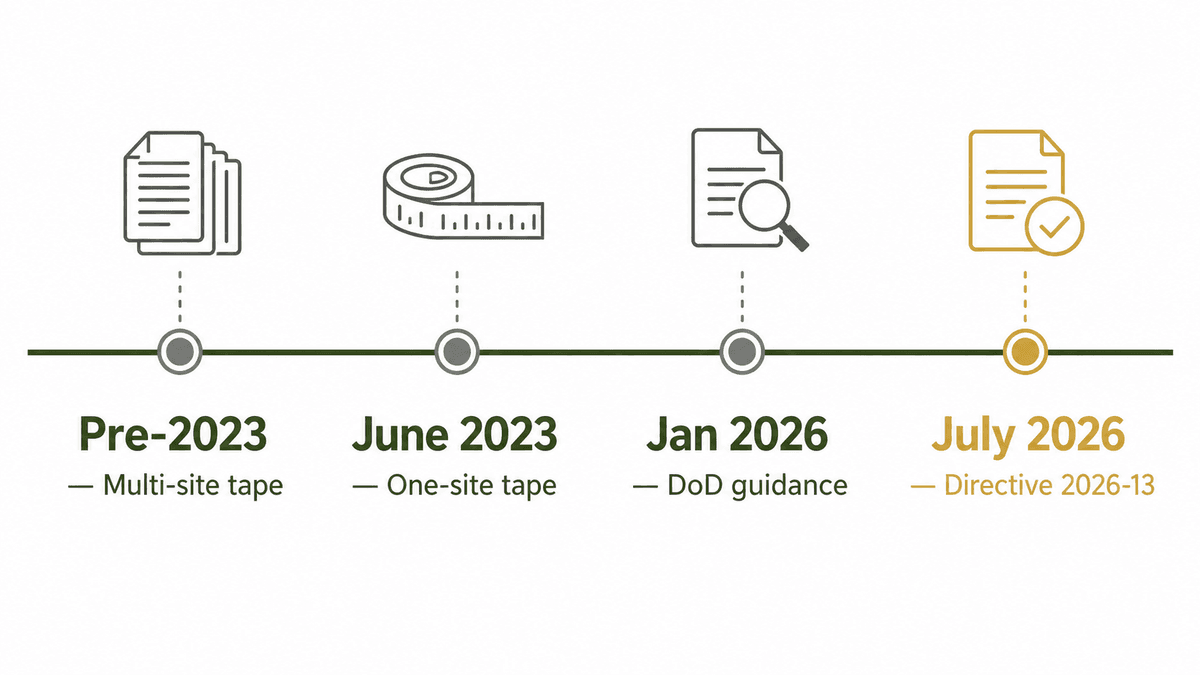
The change didn't happen overnight. Here is the full sequence, from the last major tape test change through the current standard.
- Before June 2023. The Army used a classic multi-site tape test: neck and waist for men; neck, waist, and hips for women.
- June 2023 – June 2024. Army Directive 2023-11 introduced a simplified one-site (navel-only) tape test. USARIEM research found a single abdominal measurement was a more consistent predictor of body fat than the multi-site formula. The one-site method became the only authorized circumference method Army-wide by June 8, 2024.
- January 1, 2026. The Department of War issued additional guidance ("Additional Guidance on Military Fitness Standards," dated December 18, 2025) directing every service to replace height/weight charts with waist-to-height ratio, with a threshold below 0.55, effective across the Department.
- July 7, 2026. Army Directive 2026-13, signed July 1, 2026 by Secretary of the Army Dan Driscoll, took effect. It rescinded the tape test, the height/weight tables, and every supplemental body fat method, and made WHtR the Army's sole body composition standard under AR 600-9.
Why Did the Army Make This Change?
The Army has described the change as aligning the Army Body Composition Program with medically validated, streamlined measurement approaches, in line with Department of War guidance, intended to promote consistency and fairness in how body composition is assessed across the force. WHtR also removes several sources of variation in the old tape test (technique differences between taping teams, multi-site averaging, and the age/gender adjustment tables) in favor of one number, measured the same way, for everyone. The Army also cites WHtR as a stronger long-term predictor of cardiovascular and metabolic health risk than the old formula, and points to it fitting a wider range of body types more fairly while cutting the administrative overhead of the old age- and gender-adjusted tables. Source: ABCP FAQ (army.mil)
Does This Apply the Same Way to the National Guard and Reserve?
Yes. Army Directive 2026-13 applies to the Regular Army, the Army National Guard (ARNG/ARNGUS), and the U.S. Army Reserve (USAR), with no separate standard, threshold, or timeline for any component. It also extends the WHtR standard to U.S. Military Academy cadets and Senior ROTC cadets, effective the same date, July 7, 2026.
What Do I Need to Do Right Now?
Every Soldier needs an initial WHtR measurement recorded on DA Form 5500 and in the Army Training Information System (ATIS) within 90 days of the directive's publication, a deadline landing around October 5, 2026. Leaders record the result in ATIS using the Leader Tool. After that initial catch-up, WHtR is measured twice per calendar year, the same cadence as before.
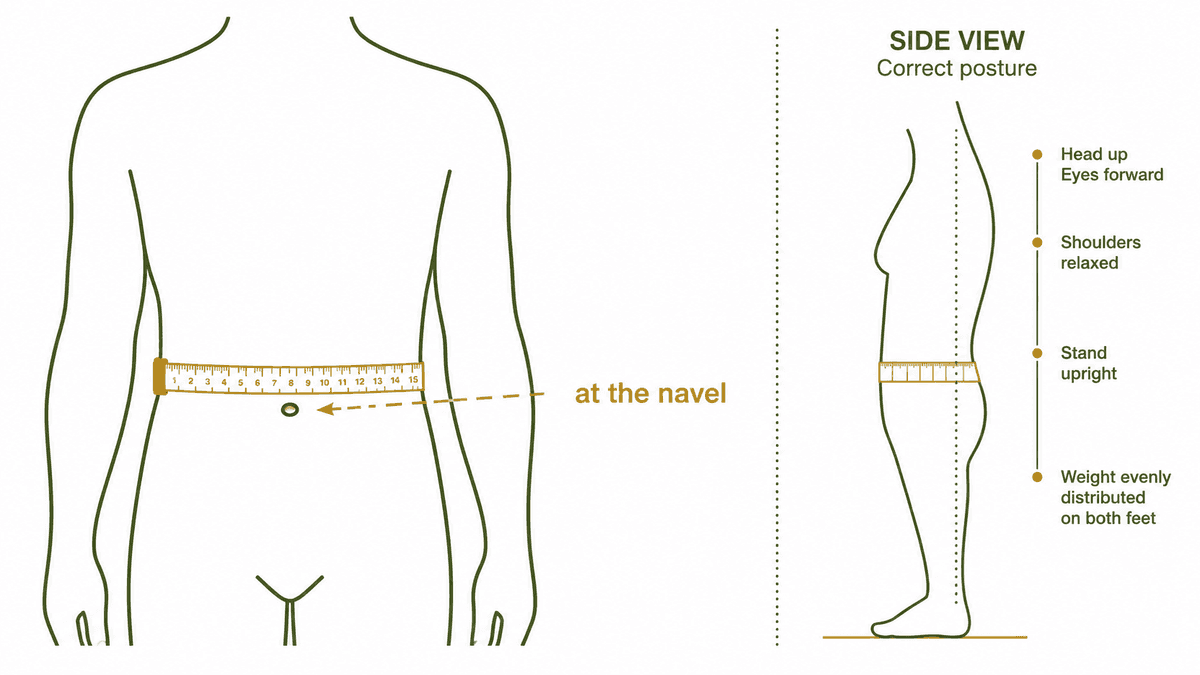
If your WHtR comes in at 0.550 or higher, a different team measures you again on the same duty day, before your commander takes any action, a built-in check against measurement error. If that confirmation also shows 0.550 or higher, you're enrolled in the Army Body Composition Program (ABCP), flagged, and stay enrolled until you meet the standard. The Army is conducting a 180-day review of the WHtR standard: no Soldier will be separated for a WHtR failure until that review is complete and further guidance is issued.
Check where you stand with the Army WHtR Calculator: it takes just your height and waist measurement, no signup required.
FAQ
Is the Army height and weight table still used? No. Army Directive 2026-13 rescinded the height and weight screening tables entirely on July 7, 2026. Waist-to-height ratio is now the only body composition screening step.
What replaced the tape test? Waist-to-height ratio (WHtR): a single measurement of waist circumference at the navel divided by height, both in inches. A result below 0.550 meets the standard.
Does a high AFT score still exempt me from a body composition check? No. Army Directive 2026-13 removed the fitness-test exemption entirely. AFT and WHtR are assessed completely independently, regardless of your score.
What happened to DA Form 5501? It's discontinued. DA Form 5500 is now used for every Soldier, since the current standard has no gender-specific version.
Is the old height and weight calculator still available? Yes, kept live as a clearly labeled historical archive at /old-army-height-and-weight-calculator for anyone researching prior policy. It does not reflect the current standard.
What if I don't get measured within the 90-day window? The directive requires every Soldier to have an initial WHtR recorded on DA Form 5500 and in ATIS within 90 days of publication, approximately October 5, 2026. Talk to your unit's Training NCO or Readiness NCO if you haven't been measured yet.
Sources
- Army modifies body composition program, adopts waist-to-height ratio (Army.mil)
- Army Directive 2026-13, Army Publishing Directorate
- Additional Guidance on Military Fitness Standards, Department of War, Dec. 18, 2025
- Army Body Composition Program FAQ, Army.mil
If you're navigating a body composition concern, Military OneSource offers free, confidential fitness and nutrition coaching for service members and families, 24/7, or call 800-342-9647.
Recommended Standards Reads
Quick internal links to the most relevant pages for AR 600-9, tape test rules, and ACFT exemptions.
- Open Army Height and Weight CalculatorCheck screening weight and estimate body fat percentage (AR 600-9).
- Old Height and Weight Calculator (Archive)Rescinded July 2026, kept for historical reference only.
- Browse All Blog ArticlesGuides on AR 600-9, tape test rules, and ACFT exemptions.
- Body fat standards chart and limits
- Army body fat calculator guide
Related Standards Articles
AR 600-9 Tape Test Rounding Rules: How to Measure Correctly
Learn how AR 600-9 tape test measurements are taken, how rounding works in real units, and how to avoid common mistakes before height and weight.
The AR 600-9 One-Site Tape Test (Rescinded July 2026)
The one-site tape test was rescinded July 7, 2026 and replaced by waist-to-height ratio. This guide explains how the old method worked and what replaced it.
Check Your Standards Now
Use the Army Height and Weight Calculator (AR 600-9) to check screening weight and estimate body fat percentage.