
Marine Corps Combat Fitness Test (CFT): Events, Scoring, Standards
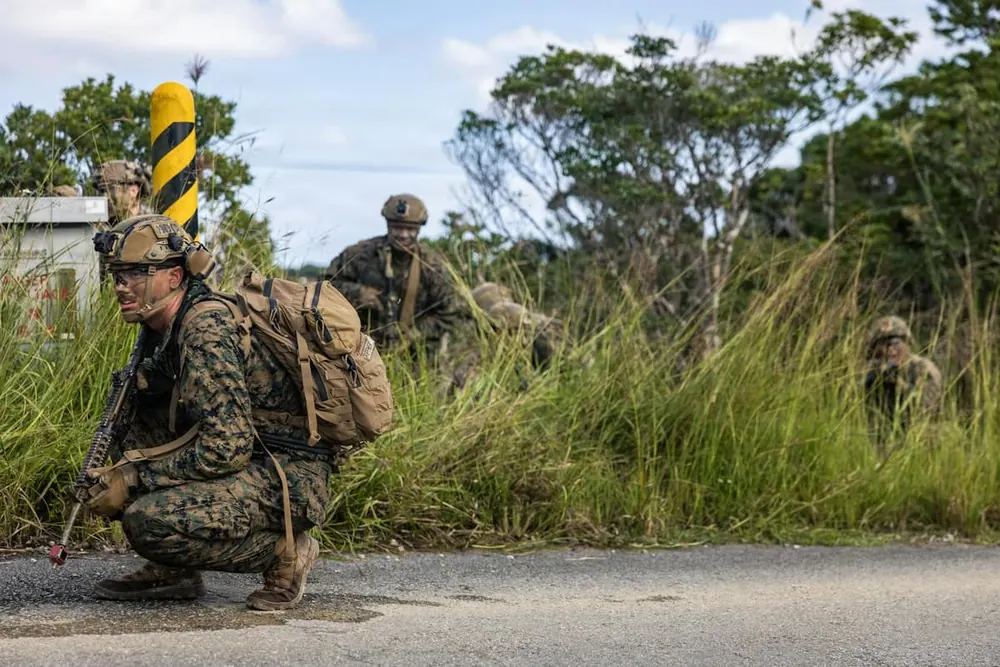
Photo via Unsplash.
The Combat Fitness Test (CFT) is the Marine Corps' functional fitness test, evaluating a Marine's capacity for combat-related physical tasks: strength, stamina, agility, and coordination. Every active-duty and reserve Marine takes it once a year, between July 1 and January 1, separate from the Physical Fitness Test (PFT).
CFT vs. PFT: What's the Difference?
Marines take two separate fitness tests on different schedules. The PFT measures general fitness through pull-ups (or push-ups), a plank, and a 3-mile run. The CFT measures functional combat fitness through three entirely different events, designed to simulate tasks a Marine might actually perform in the field. The two complement each other rather than overlap.
The Three CFT Events
- Movement to Contact (MTC): an 880-yard run (two laps around a track) in boots and utilities, simulating a rapid movement toward contact.
- Ammo Can Lift: lifting a 30-lb ammunition can overhead from shoulder height, for maximum repetitions in 2 minutes.
- Maneuver Under Fire (MUF): a timed 300-yard shuttle event, performed in pairs, combining sprints, an agility course, high crawl, low crawl, a body drag, a fireman's carry, an ammo can carry, push-ups, and a grenade throw.
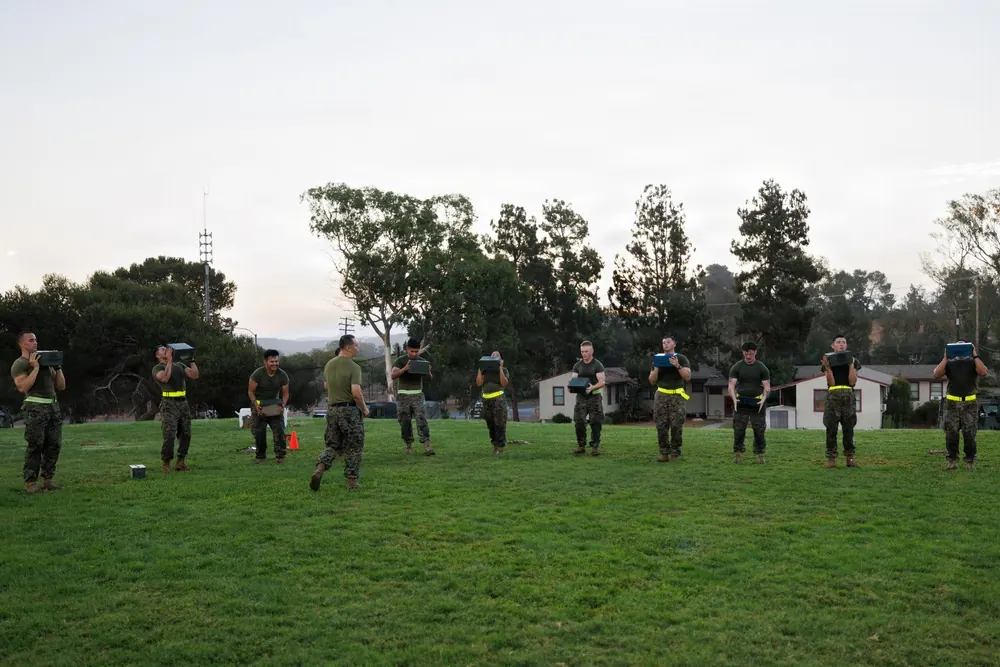
Marines practice ammo can lifts during unit PT at Camp Pendleton, Calif., Aug. 2026. U.S. Marine Corps photo by Lance Cpl. Katherine Fohn (DVIDS, public domain).
CFT Scoring Standards by Age Group
The tables below show minimum (passing floor) and maximum (100-point) standards for male Marines. As of 2019, minimum standards were raised across the board: scoring exactly the old minimum no longer passes.
Movement to Contact (minimum / maximum time)
| Age Group | Minimum | Maximum |
|---|---|---|
| 17-20 | 3:45 | 2:40 |
| 21-25 | 3:45 | 2:38 |
| 26-30 | 3:48 | 2:39 |
| 31-35 | 3:51 | 2:42 |
| 36-40 | 3:58 | 2:45 |
| 41-45 | 4:11 | 2:52 |
| 46-50 | 4:28 | 3:01 |
| 51+ | 5:07 | 3:05 |
Ammo Can Lift (minimum / maximum reps)
| Age Group | Minimum | Maximum |
|---|---|---|
| 17-20 | 62 | 106 |
| 21-25 | 67 | 115 |
| 26-30 | 67 | 116 |
| 31-35 | 67 | 120 |
| 36-40 | 67 | 110 |
| 41-45 | 66 | 106 |
| 46-50 | 65 | 100 |
| 51+ | 16* | 95 |
*As published on military.com; this figure is a notable outlier against the 61-67 minimums in every other age group, so treat it as unverified pending a check against the current MCO 6100.13 rather than a confirmed standard.
Maneuver Under Fire (minimum / maximum time)
| Age Group | Minimum | Maximum |
|---|---|---|
| 17-20 | 3:17 | 2:07 |
| 21-25 | 3:18 | 2:45 |
| 26-30 | 3:22 | 2:42 |
| 31-35 | 3:30 | 2:49 |
| 36-40 | 3:42 | 2:53 |
| 41-45 | 3:59 | 2:57 |
| 46-50 | 4:14 | 3:35 |
| 51+ | 6:09 | 3:44 |
Female Marine standards follow the same three-event structure with sex-specific times and reps. Consult Marine Corps Order 6100.13 for the complete, current female tables and any interim updates.
Rest Periods and Recent Changes
Marines get 3 minutes to rest between CFT events, down from the previous 5 minutes. Combined with the 2019 increase to minimum standards, the current CFT is measurably harder to pass than earlier versions.
Preparing for the CFT
Because the CFT's three events don't resemble typical gym training, targeted preparation matters more than general fitness. A few notes specific to each event:
- MTC: train at the actual test pace (roughly a mile-and-a-half race pace, not distance-running pace), since 880 yards rewards speed over endurance.
- Ammo Can Lift: shoulder-press endurance, not one-rep max strength, drives this score. High-rep overhead pressing with lighter loads builds the specific stamina this event tests.
- MUF: because it combines sprinting, crawling, and carrying in one continuous event, training the transitions between movements (not just each movement in isolation) is what most CFT prep misses.
Not the Same as the Army's Fitness Test
The Army's equivalent test, the Army Fitness Test (AFT), uses a different event list (deadlift, hand-release push-up, sprint-drag-carry, plank, 2-mile run) and a 0-100 point scoring scale rather than the CFT's minimum/maximum structure. See our AFT standards and score chart, or score your own results with the AFT Calculator, if you're comparing the two services' approaches to fitness testing.
If you're a Marine checking your body composition rather than your fitness score, the Marine Corps uses its own waist-to-height ratio standard, separate from both the CFT and PFT: see the Marine Corps WHtR Calculator.
Sources
Recommended Fitness Reads
Quick links to the most relevant pages for the WHtR standard, AR 600-9, and the Army Fitness Test.
- Army WHtR CalculatorCheck your waist-to-height ratio against the current 0.550 standard (Army Directive 2026-13).
- ABCP CalculatorSee what a result at or above 0.550 means: confirmation retest, enrollment, and the 180-day review.
- Browse All Blog ArticlesGuides on the WHtR standard, AR 600-9, and the Army Fitness Test.
- AFT Calculator
- AFT standards and score chart
- AFT sprint-drag-carry guide
- Army PFT: the old Physical Fitness Test
Related Fitness Articles
AFT Standards and Score Chart: How the Army Fitness Test Works
The Army Fitness Test (AFT) replaced the ACFT on June 1, 2025. Here's how its five events are scored, what the pass/fail structure requires, and how to read the official score chart for your age and category.
Sprint-Drag-Carry (SDC): AFT Standards and How to Train It
The Sprint-Drag-Carry is the AFT's most technical event: five 50-meter shuttles combining a sprint, sled drag, lateral shuffle, loaded carry, and sprint. Here's how it's scored and how to train each phase.
Related Calculators
- Army WHtR CalculatorCheck your current waist-to-height ratio against the 0.550 ABCP standard.
- Army Body Fat CalculatorSee what replaced the old body fat percentage standard, archived for reference.
- ABCP CalculatorCheck your WHtR against the ABCP standard and see what enrollment would mean.
- AFT CalculatorScore your Army Fitness Test events using the official scoring tables.
Check Your Standards Now
Use the Army WHtR Calculator to check your waist-to-height ratio against the current 0.550 standard.