
How to Measure Your Waist Accurately (Alone or With Help)
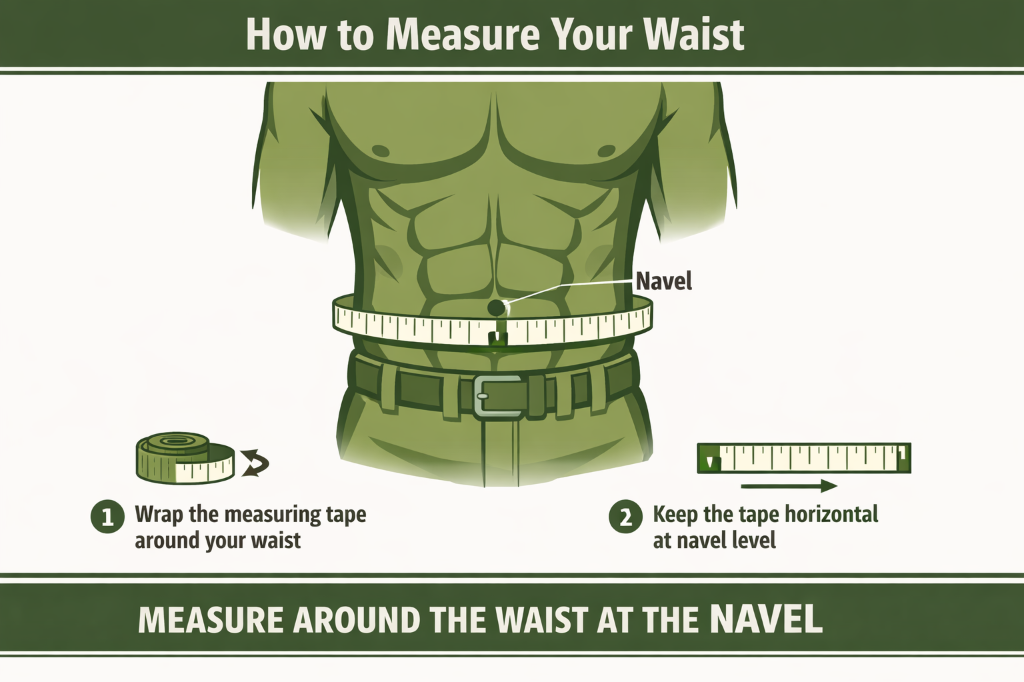
Level, snug, at the navel, after a normal exhale: the four things that matter.
As an Amazon Associate I earn from qualifying purchases. This post contains affiliate links; we may earn a small commission from qualifying purchases at no extra cost to you.
Learning how to measure your waist accurately, alone or with a battle buddy, is worth doing right. Your official WHtR measurement is whatever your unit records, not a number you calculate at home, but knowing the correct technique means no surprises at your next assessment, and lets you track a real trend instead of noise. Here's the technique, step by step.
Before You Measure
Pick a consistent time of day and stick with it. Waist circumference shifts a little over the course of a day with food, water, and activity, so a reading taken first thing in the morning isn't directly comparable to one taken after dinner. It doesn't need to match your unit's assessment schedule exactly; it needs to match itself, week over week, so the number you're tracking reflects a real trend rather than the time you happened to measure. Wear little to nothing around your midsection when you measure, since even a thin shirt bunched under the tape can add a small amount of thickness that a consistent routine would otherwise cancel out.
Where to Measure
Find your navel (belly button). That's the fixed reference point for the current standard, not the narrowest point of your torso and not the top of your hip bones. Stand upright with your feet about shoulder-width apart and your arms relaxed at your sides. Breathe out normally, once, and measure at that point, without holding your breath, sucking in, or pushing your stomach out. Any of those will throw off the number in a way that doesn't reflect your actual waist.
Measuring Alone
Wrap the tape around your waist at the navel. Keep it level and horizontal the entire way around; a common solo mistake is letting the tape ride higher in back than in front, since you can't see behind yourself. A mirror positioned to the side, not straight ahead, lets you check the line at your hip rather than just the front. Keep the tape snug against the skin without compressing it. If you can see an indentation where the tape sits, it's too tight; if you can easily slide a finger underneath, it's too loose. Read the number, then release.
Measuring With a Battle Buddy
A second person is the biggest accuracy upgrade available, and it costs nothing. One person holds the tape level at the back while the other holds it at the front and reads the measurement, which removes the back-riding error entirely and lets both people confirm the tape is snug and level before anyone reads a number. This is closest to how an actual assessment works, with a second team member confirming the measurement rather than one person guessing at their own back.
Agree on the exhale before you start. Have the person being measured breathe out normally, once, and take the reading right at the end of that exhale, not after holding for several seconds, which tends to make people unconsciously tense their midsection. The person reading the tape should call out the number out loud rather than writing it down first from memory, so there's no gap for a rounded-off or misremembered figure to creep in. If the first two readings taken this way don't match closely, reset the tape and take a third rather than assuming one of the first two was correct.
Common Errors, Described
The tape rides up in back. From the front it looks level, but the tape actually slopes upward toward the spine, effectively shortening the measured distance. This is the single most common solo-measuring mistake, and a mirror or a second person is the direct fix.
Measuring over bulky clothing. A sweatshirt or jacket under the tape adds real inches that aren't part of your waist. Measure against skin or a single thin layer.
Sucking in or pushing out. Both distort the reading in opposite directions. A normal, relaxed exhale, the same way each time, is what makes repeated measurements comparable to each other.
Inconsistent tension. Pulled too tight, the tape compresses skin and reads short; held too loose, it reads long. Snug against the skin without denting it is the target every time, which is easier to repeat consistently with a tape that has a lock or hold function.
Measuring at random times of day. Waist size shifts a little with food, water, and time of day. Pick one consistent time, ideally before eating, so week-to-week changes reflect a real trend and not normal daily fluctuation.
Reading the tape at an angle. Looking down at the number instead of level with it can make the tape appear to show a different value than it actually does, an effect known as parallax. Bend at the knees or use a mirror so you're reading the marking straight on.
Why Self-Measuring Accurately Actually Helps
None of this replaces your unit's official measurement, and it isn't meant to. What it does is remove surprises. If you have a consistent, accurate self-measurement routine, you'll already know roughly where you stand before an official screening, which means a result near the 0.550 line won't catch you off guard, and a confirmation retest, if one happens, is a procedural step rather than a shock. Soldiers who only find out their number on assessment day have no way to tell whether a borderline result reflects a real trend or a one-off measurement issue. A few minutes of consistent tracking between assessments is the difference.
The Tool Matters Too
Technique only gets you so far if the tape itself is inaccurate. A cloth tape that's stretched from wear, or one with coarse markings that force you to estimate between lines, introduces error no amount of good technique can correct. We cover what to look for, and our specific pick, in our tape measure guide and on the recommended gear page.
FAQ
How many times should I measure before trusting the number? Take two readings and compare them. If they're close, you have your number. If they differ noticeably, reset the tape completely and take a third rather than assuming either of the first two was right.
Does it matter if I measure over a T-shirt? A single thin layer has a small, fairly consistent effect and is fine if you do it the same way every time. Bulky clothing, or switching between measuring on skin and over clothes, is what actually distorts a trend.
Why does my self-measurement look different from my unit's official one? Small differences are normal; a different person measuring, a slightly different moment in your breathing cycle, or your own tape's accuracy can all account for it. Large, consistent differences usually point to technique or a stretched tape.
Should I measure at the same time every day? Same time of day, ideally before eating, is what makes repeated measurements comparable. It doesn't need to match any official schedule; it needs to be consistent with your own prior readings.
Once you've got a good measurement, check exactly where you stand with the Army WHtR Calculator. If you're within range of the standard, remember that a trend measured consistently over weeks tells you far more than any single reading taken the day before an assessment.
Recommended Tutorial Reads
Quick internal links to the most relevant pages for AR 600-9, tape test rules, and ACFT exemptions.
Related Tutorial Articles
AR 600-9 Tape Test Rounding Rules: How to Measure Correctly
Learn how AR 600-9 tape test measurements are taken, how rounding works in real units, and how to avoid common mistakes before height and weight.
The AR 600-9 One-Site Tape Test (Rescinded July 2026)
The one-site tape test was rescinded July 7, 2026 and replaced by waist-to-height ratio. This guide explains how the old method worked and what replaced it.
Check Your Standards Now
Use the Army Height and Weight Calculator (AR 600-9) to check screening weight and estimate body fat percentage.