The New Army One-Site Tape Test Guide
In June 2023, the United States Army implemented one of the most significant changes to its body composition standards in over forty years. With the release of Army Directive 2023-11, the military transitioned from the long-standing multi-site circumference-based assessment (often referred to as the "neck and waist" or "waist and hips" test) to a modernized, simplified one-site tape test.
For Soldiers, staying within the official Army body fat standards is not just about health; it's about professional survival. Failing to meet these standards can lead to being "flagged" under the Army Body Composition Program (ABCP), which halts promotions, transfers, and military schooling. This guide provides a deep dive into the new AR 600-9 requirements, the math behind the army body fat calculator formula, and how you can prepare for success.
The Evolution of AR 600-9: Why the Change?
The Army's decision to move to a one-site tape test wasn't arbitrary. It was the result of a comprehensive study conducted by the U.S. Army Research Institute of Environmental Medicine (USARIEM). The study compared the traditional tape test methods against the "Gold Standard" of body composition: the Dual-Energy X-Ray Absorptiometry (DEXA) scan.
The Problem with the Old Method
The previous army body fat calculator neck and waist method was often criticized by Soldiers and fitness experts alike. For men, the formula relied heavily on the difference between the neck and waist circumference. Critics argued that this penalized "thick-necked" Soldiers who had significant muscle mass but might technically exceed the max allowable waist size. Conversely, some Soldiers would actively try to "build their neck" through specific exercises or even dehydration tricks to skew the results.
The Scientific Shift
USARIEM's data showed that a single measurement at the abdominal level (the navel) was actually a more consistent predictor of true body fat percentage across a diverse population of Soldiers. By simplifying the measurement to one site, the Army reduced the margin for human error and administrative burden during unit weigh-ins.
How the New One-Site Tape Test Works
As of June 8, 2024, the one-site tape test is the only authorized circumference-based method for all components, including the Regular Army, National Guard, and Army Reserve. If you are using an Online Army Body Fat Calculator, ensure it is updated to reflect this single-measurement logic.
The Measurement Procedure
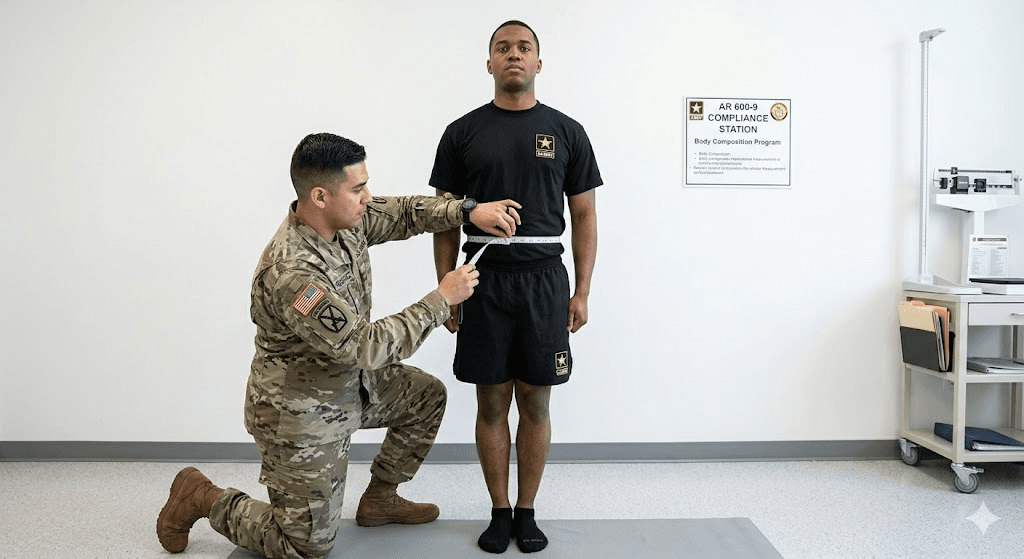
According to the official Army Body Fat Assessment directive, the measurement must be conducted with extreme precision:
- The Navel Site: The tape is placed horizontally around the abdomen at the level of the navel (belly button).
- Body Alignment: The Soldier must stand upright with arms at their side, looking straight ahead.
- Rounding Rules: The measurement is taken to the nearest 1/2 inch. For example, if a measurement is 34.25 inches, it is rounded to 34.5 inches.
- The Average: The NCO performing the test must take three separate measurements and use the average of the three for the final calculation.
Accuracy and Weight
It's important to remember that the army body fat percentage calculator still requires your current body weight. The formula uses the relationship between your waist circumference, height, and weight to determine your estimation.
The ACFT 465 Exemption: The Ultimate Pass
One of the most revolutionary additions to the current regulation is the performance-based exemption. The Army now acknowledges that elite athletes come in all shapes and sizes. Under the updated standards, Soldiers who score a 465 or higher on the record ACFT (with at least 80 points in every event on standard events) are completely exempt from being taped, regardless of their weight. Previously, this threshold was 540+.
For more details on how to use your fitness score to bypass the tape, visit our guide on ACFT Score and Body Fat Exemptions.
What Happens if You Fail the New Tape Test?
The Army has introduced a "Safety Net" for Soldiers who might be outliers in the circumference-based formula. If you fail the one-site tape test, you are not immediately doomed to the ABCP.
Supplemental Body Fat Assessments
Per the latest ALARACT messages, Soldiers who fail the circumference assessment have the right to request a Supplemental Body Fat Assessment. These are far more accurate than a tape measure and include:
- DEXA Scan: Uses low-level X-rays to measure bone density, muscle, and fat.
- Bod Pod: Uses air displacement plethysmography to determine body volume and density.
- InBody 770: A bioelectrical impedance analysis (BIA) tool that measures water and fat content.
If the Soldier passes any of these supplemental tests, the "Flag" for body composition is removed, and they are considered in compliance. If they fail the supplemental test or choose not to take one, they are officially enrolled in the Army Body Composition Program.
Pro-Tips for Passing the Height and Weight Screening
Success at the scale starts months before the actual weigh-in. Here are some researched strategies for ensuring you stay below the max allowable:
1. Frequent Self-Monitoring
Stop guessing. Use a U.S. Army Body Fat Calculator every two weeks. Tracking your trends allows you to make minor dietary adjustments before they become major career problems.
2. Sodium and Water Management
In the 48 hours leading up to a weigh-in, many Soldiers find success by reducing sodium intake. Excess salt causes the body to retain water, specifically in the abdominal area where the one-site measurement is taken. By drinking consistent water but cutting the salt, you can often "de-bloat" enough to lose a half-inch on the tape.
3. Posture Matters
When being measured at the navel, maintaining an upright, military posture is essential. While you cannot "suck it in" (this is a violation of the regulation and will be corrected by the NCO), standing tall ensures the tape lies horizontally and doesn't dip, which could lead to a larger circumference reading.
4. Focus on the ACFT
The 465 exemption rule is the only 100% guaranteed way to avoid the stress of the tape. If you are consistently hovering near the maximum allowable body fat, your time might be better spent in the gym improving your ACFT score than on a "crash diet" that weakens your performance.
Summary: Readiness is the Standard
The transition to the one-site tape test reflects the Army's commitment to a more modern, scientifically-backed force. By simplifying the army body fat standards calculator process, the Army is emphasizing overall health and performance over arbitrary neck sizes. Stay informed, stay active, and use the tools available to you to ensure you remain mission-ready.
External Resources & Citations:

Recommended Regulations Reads
Quick internal links to the most relevant pages for AR 600-9, tape test rules, and ACFT exemptions.
- Open Army Height and Weight CalculatorCheck screening weight and estimate body fat percentage (AR 600-9).
- ABCP CalculatorComplete Army Body Composition Program calculator under AR 600-9 standards.
- Browse All Blog ArticlesGuides on AR 600-9, tape test rules, and ACFT exemptions.
- Army body fat standards by age and gender
Related Regulations Articles
AR 600-9 Tape Test Rounding Rules: How to Measure Correctly
Learn how AR 600-9 tape test measurements are taken, how rounding works in real units, and how to avoid common mistakes before height and weight.
7 Tips to Prepare for Your Next Height and Weight Screening
Height and weight doesn't have to be stressful. Follow these 7 tips to ensure you're within standards on the big day.
Check Your Standards Now
Use the Army Height and Weight Calculator (AR 600-9) to check screening weight and estimate body fat percentage.