
Military Height and Weight Standards 2026: Every Branch Compared
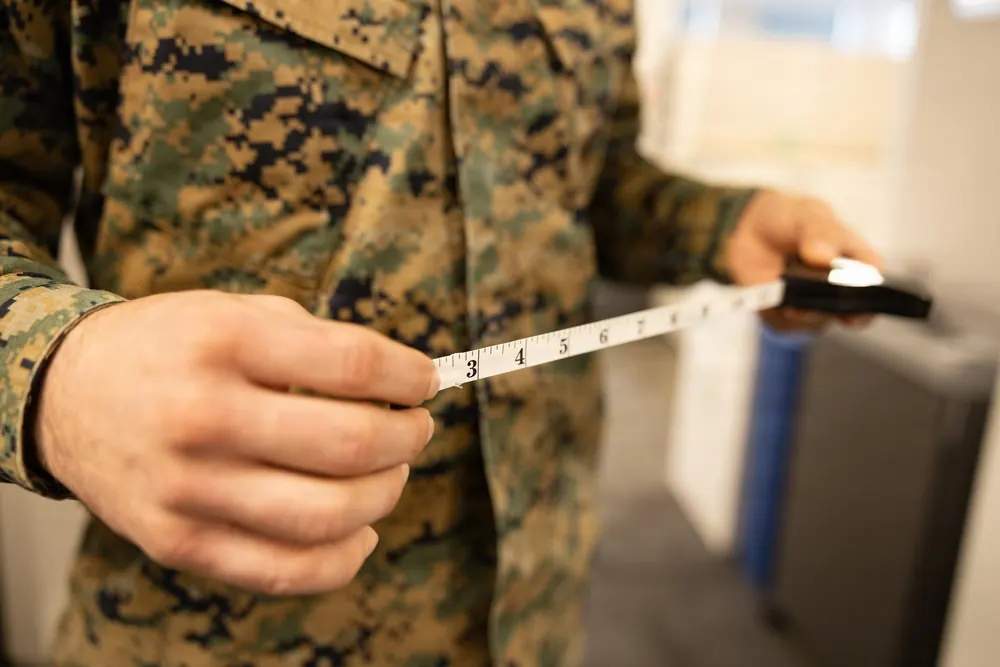
A retractable body tape used for body composition measurement, Marine Corps Base Quantico, Feb. 2026. U.S. Marine Corps photo by Staff Sgt. Claudia Nix (DVIDS, public domain).
Every U.S. military branch now judges body composition by waist-to-height ratio (WHtR): your waist divided by your height, both in the same unit. Weight tables are gone for people in uniform. The idea is the same everywhere, but the details are not. The Marine Corps draws a tighter line, the Air Force puts the tape in a different place, and the Navy keeps a second step that the Army dropped.
This guide puts the five services side by side, using each branch's own rules.
The short version
| Branch | Pass line | Where the tape goes | If you are over the line | Rule |
|---|---|---|---|---|
| Army | Below 0.550 | Navel | Confirmation retest, then the Army Body Composition Program | Army Directive 2026-13 (July 7, 2026) |
| Marine Corps | 0.520 | Navel | Multi-site tape test or BIA scan, then the Marine Corps Body Composition Program | Marine Corps change, effective Feb. 2026 |
| Navy | 0.5499 or less | Navel | Step 2: body fat estimate from weight; within 26% (men) or 36% (women) still passes | Navy Guide-4, Body Composition Assessment (June 2026) |
| Air Force | Below 0.550 | Midpoint of lowest rib and top of hip bone | Counts against the body composition part (20%) of the fitness assessment | Department of the Air Force body composition program |
| Space Force | Below 0.550 | Same as Air Force | Same as Air Force | Department of the Air Force body composition program |
None of the five adjusts the first-step line for age or sex.
Waist line by height: 0.550 vs 0.520
The table shows the waist at which each line is reached. For the Army, Air Force, Space Force and Navy, your waist has to be below the 0.550 figure. The Marine Corps figure is its 0.520 line.
| Height | Waist line at 0.550 (Army, Navy, Air Force, Space Force) | Waist line at 0.520 (Marine Corps) | Difference |
|---|---|---|---|
| 5'0" (60 in) | 33.0 in | 31.2 in | 1.8 in |
| 5'2" (62 in) | 34.1 in | 32.2 in | 1.9 in |
| 5'4" (64 in) | 35.2 in | 33.3 in | 1.9 in |
| 5'6" (66 in) | 36.3 in | 34.3 in | 2.0 in |
| 5'8" (68 in) | 37.4 in | 35.4 in | 2.0 in |
| 5'10" (70 in) | 38.5 in | 36.4 in | 2.1 in |
| 6'0" (72 in) | 39.6 in | 37.4 in | 2.2 in |
| 6'2" (74 in) | 40.7 in | 38.5 in | 2.2 in |
| 6'4" (76 in) | 41.8 in | 39.5 in | 2.3 in |
| 6'6" (78 in) | 42.9 in | 40.6 in | 2.3 in |
The gap grows with height: about 2 inches of waist for most service members. For every height from 4'10" to 6'8", with centimeters, see the Army height and weight chart.
Army
The Army made WHtR its only body composition test on July 7, 2026 (Army Directive 2026-13). The waist is taken at the navel. The ratio is cut at three decimals, not rounded, so 0.549 passes and 0.550 fails. There is no weight table and no tape-test body fat estimate any more.
A Soldier at or above 0.550 gets a confirmation measurement and, if it holds, is enrolled in the Army Body Composition Program. Check your number with the Army WHtR calculator, and see AR 600-9 explained for the program itself.
Marine Corps
The Marine Corps chose 0.520, the strictest line of any branch (Military.com, Military Times). The waist is measured at the navel, twice, by a same-sex evaluator. The same line applies to every Marine regardless of sex or age.
A Marine who measures at or above 0.520 is not out straight away: the next step is a body fat check by multi-site tape test or bioelectrical impedance (BIA). Failing that leads to the Marine Corps Body Composition Program. Try the Marine Corps WHtR calculator.
Navy
The Navy's Body Composition Assessment guide (Guide-4, June 2026) uses three numbers: height, waist at the belly button, and weight. The neck measurement is gone.
- Step 1: a ratio of 0.5499 or less (rounded down to four decimals) passes.
- Step 2: a ratio of 0.5500 or more is not a failure yet. Weight and height-minus-waist give an estimated body fat from a printed table. Within 26% for men or 36% for women still meets the standard.
That second step is the main difference from the Army, which has no fallback after the ratio. Run both steps with the Navy body fat calculator.
Air Force and Space Force
The Department of the Air Force uses the same 0.550 line for Airmen and Guardians (af.mil). Two things are different:
- Tape position. The waist is measured halfway between the lowest rib you can feel and the top of the hip bone, not at the navel. That point is usually higher and narrower, so do not reuse an Army-style navel measurement.
- How it counts. Body composition is one component, worth 20% of the Physical Fitness Assessment. A ratio at or above 0.550 scores as not meeting that component and is treated as high risk, rather than being an instant overall failure on its own. Members are measured twice a year.
Check it with the Air Force WHtR calculator.
Joining the military: MEPS is different
Everything above applies to people already serving. Applicants are screened at the Military Entrance Processing Station under DoDI 6130.03, which still starts with a height and weight table and moves to a body fat measurement for anyone over the maximum. Being over the table is not an automatic disqualification. Details are in Army weight requirements for recruits.
Measuring yourself at home
- Stand straight, feet together, breathing out normally.
- Put the tape where your branch measures (navel, or the rib-to-hip midpoint for the Air Force and Space Force).
- Keep the tape level all the way around and snug, without pressing into the skin.
- Read it to the nearest half inch and repeat to check.
- Measure height without shoes.
A home number is a planning estimate. Your official result is the one your unit records. Our guide on how to measure your waist accurately has photos of each step.
Sources
- Army Directive 2026-13, Army Body Composition Program (Army Publishing Directorate)
- Marines ditch traditional height-weight method (Military.com, Feb. 27, 2026)
- Navy Guide-4, Body Composition Assessment (MyNavy HR)
- Department of the Air Force body composition program (af.mil)
- Military OneSource: fitness and nutrition
Recommended Standards Reads
Quick links to the most relevant pages for the WHtR standard, AR 600-9, and the Army Fitness Test.
- Army WHtR CalculatorCheck your waist-to-height ratio against the current 0.550 standard (Army Directive 2026-13).
- ABCP CalculatorSee what a result at or above 0.550 means: confirmation retest, enrollment, and the 180-day review.
- Browse All Blog ArticlesGuides on the WHtR standard, AR 600-9, and the Army Fitness Test.
- Army height and weight chart 2026
- What changed on July 7, 2026
- How to meet the Army WHtR standard
Related Standards Articles
US Army Height and Weight Standards 2026: Current Rules and the Old Tables
The AR 600-9 height/weight screening tables and body fat limits were rescinded July 7, 2026. Here is what replaced them, plus the old tables for historical reference.
How to Meet the Army WHtR Standard (The Tape Test Is Gone)
The Army tape test was rescinded July 7, 2026. Here is how the current waist-to-height ratio (WHtR) standard works, how to measure correctly, and how to plan ahead: no cutting tricks.
Related Calculators
- Army WHtR CalculatorCheck your current waist-to-height ratio against the 0.550 ABCP standard.
- Army Body Fat CalculatorSee what replaced the old body fat percentage standard, archived for reference.
- ABCP CalculatorCheck your WHtR against the ABCP standard and see what enrollment would mean.
- AFT CalculatorScore your Army Fitness Test events using the official scoring tables.
Check Your Standards Now
Use the Army WHtR Calculator to check your waist-to-height ratio against the current 0.550 standard.